NSPC 2026 Summer Interns Conclude a Summer of National Security Research
August 4, 2026
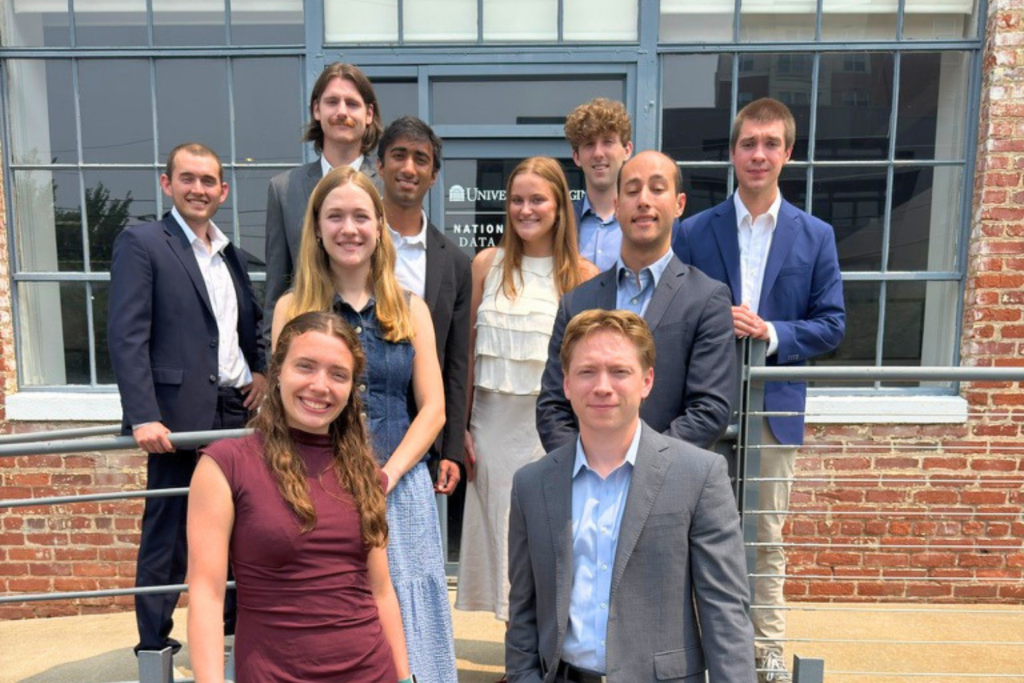 Last week, the National Security Policy Center’s (NSPC) 2026 summer interns wrapped up their internships, closing out two months of research conducted for the University of Virginia’s National Security Data and Policy Institute (NSDPI). Sponsored by Washington Harbour, this year’s program drew nine undergraduate and graduate students from across the University of Virginia to work on questions ranging from undersea competition in the Pacific to the security of the American food supply.
The internship followed the two-part structure that has come to define the NSPC’s summer program. In the first half, the cohort split into two teams, each producing a literature review for the NSDPI; in the second, each intern researched and wrote an individual policy white paper on a national security topic approved by NSDPI supervisors. Between these main efforts, interns also had opportunities to assist with research for Sea Power, a NSPC initiative dedicated to the future of sea power and U.S. naval policy. This year’s cohort comprised undergraduates Rohan Iyer, Phillip Johnson, Owen Leshner, Jane McGuiggin, and Maeve Myers; Master of Public Policy candidates Charles Burns, Brooke Livergood, and Peter Sullivan; and Trevor Hamilton, a rising second-year MPP candidate who served as the group’s advisor.
Two Team Literature Reviews
The two literature reviews were commissioned as applied groundwork for the NSDPI, not as classroom exercises. Each product was shaped in part by the Institute researchers who would go on to use it: the defense-infrastructure team’s review will support the NSDPI’s ongoing collaboration with UVA’s School of Architecture, while the food-security team worked closely with NSDPI Senior Researcher Nathan Timbs. Intern advisor Trevor Hamilton guided both teams through the research and drafting process.
 Team one was comprised of interns Brooke Livergood, Jane McGuiggin, Maeve Myers, and Peter Sullivan. Together they examined how states and militaries have historically used natural objects and environmental processes, from waterways and terrain to forests and coastlines, as defense infrastructure, and what that record offers U.S. policymakers today. The question carries weight: the Department of War manages roughly 5,000 installations worldwide valued at more than $1 trillion, a third of them in coastal areas exposed to sea-level rise and extreme weather, with climate-related damage costing an estimated $15 billion over the past decade. Alongside historical case studies, the review also looks closely at how China has adapted its own policy to mitigate risks to the 44 percent of its population and 61 percent of its GDP concentrated in vulnerable coastal regions, drawing lessons the U.S. military might apply to installations at home and abroad. The team distilled its analysis into six takeaways for policymakers. Because the project was written for the Natural Infrastructure Lab at UVA’s School of Architecture — a recent NSDPI partner that builds coastal resilience from plants, sediment, and natural processes rather than concrete and steel — the full cohort also visited the lab to see the concepts applied in person.
 The second team was comprised of interns Charles Burns, Rohan Iyer, Phillip Johnson, and Owen Leshner. Together, they surveyed the natural and intentional biological threats facing the U.S. food supply. Traditional definitions of agroterrorism center on the deliberate introduction of a pathogen into crops or livestock to sow fear and disorder, and the team traced how that understanding has developed since the subject entered mainstream policy discussion after September 11th. They found that research has advanced along a fairly linear path since 2001 but has not kept pace with two faster-moving developments: the infusion of artificial intelligence into synthetic biology and the spread of AI-generated misinformation about the food system. The review maps the methods researchers currently use to distinguish natural, accidental, and deliberate outbreaks, and identifies where policymakers will need better tools as those technologies mature.
Both teams presented their reviews on June 25th to outgoing Frank Batten School Dean Ian Solomon, NSDPI staff, and other national security professionals. The reviews, backgrounder memos, and slide decks they produced will serve as a foundation for the Institute’s continuing research. Together, the two projects reflect the breadth of questions the summer program puts to its interns and the standard of work the NSDPI helps them to achieve.
Individual White Papers
In the second half of the summer, interns turned to individual research projects. Each conducted research and wrote an original white paper on a critical issue for U.S. defense. Their work explored a wide variety of topics, tracing much of the current national security landscape.
 Two papers examined undersea competition between the United States and China in the Pacific. Phillip Johnson analyzed China’s National Oceanographic Survey Fleet, arguing that its dual-use seabed mapping within and beyond the First and Second Island Chains advances anti-submarine and undersea-denial capabilities that erode the United States’ asymmetric undersea advantage. Peter Sullivan turned to hardware, assessing China’s Extra Large Unmanned Underwater Vehicle (XLUUV) fleet and finding that the People’s Liberation Army Navy has operationalized or is developing at least five models — enough to lead the United States in scaled unmanned underwater weaponization.
Interns also explored themes of economic competition. Brooke Livergood examined Kazakhstan’s multi-vector foreign policy and its critical-minerals trade with the United States, Russia, and China, concluding that outdated policy and lagging investment have caused the U.S. to miss engagement opportunities with a potentially crucial trade partner. Owen Leshner widened the lens to the broader asymmetry in economic dependency between China and the West, finding that at the commodity level the United States and its allies hold little leverage to answer Chinese economic coercion (the most economically significant good China imports from allied nations is a tropical fruit). His paper argues for coordinated economic statecraft, including reinstating NATO’s Economic Committee, which was disbanded in 2010.
Focusing on an active and evolving conflict, Jane McGuiggin’s research scrutinized the consequences of ongoing military action in the Middle East. While rapid developments there present decision-makers with a series of fluid challenges day-to-day, McGuiggin’s white paper weighs the long-term implications of unfolding events. She studied the second-order effects of the degradation of Iran’s “Axis of Resistance,” warning that the security vacuums it creates could fuel a resurgence of Sunni jihadist organizations and further decentralize Iran’s proxy network. Drawing on earlier U.S. counterterrorism campaigns, her analysis emphasizes multilateral cooperation and local partnerships over decapitation strikes alone.
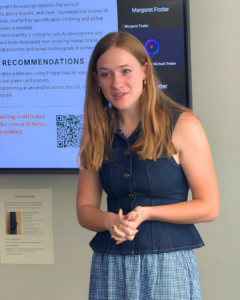
Closer to home, two interns turned to security in the Western Hemisphere. Charles Burns analyzed Colombian President Gustavo Petro’s “Total Peace” initiative, the government’s effort to negotiate simultaneous ceasefires with the country’s armed groups. He found that while the unconditioned ceasefires precipitated a 28 percent decline in violent events involving security forces during Petro’s first 27 months, armed groups exploited the reprieve to consolidate. Their combined membership grew by more than 5,000 in 2025 alone to exceed 27,000, even as displacement and kidnapping continued to burden Colombian citizens. Rohan Iyer, meanwhile, examined how Mexican cartels use social media to recruit new members, particularly among the young. He describes how cartel-linked accounts advertise “work” and romanticize organized crime while evading platforms’ content moderation, and sets out policy options for disrupting that pipeline — from strengthening moderation tools to investing in economic development in Mexico.
A final pair looked at the information environment and emerging technology. Trevor Hamilton evaluated the disinformation strategy behind Hungary’s 2026 parliamentary elections, drawing on European Social Survey data to argue that incumbent Viktor Orbán’s reliance on traditional media over social platforms undercut his own campaign against Péter Magyar’s insurgent Tisza party. Maeve Myers examined the identification and development of AI talent in the United States, recommending AI-specific immigration pathways and interdisciplinary university programming to close a talent gap with India and China.
Professional Development Opportunities
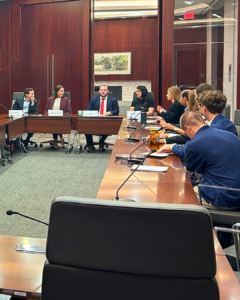
Professional development was also a key component of the NSPC summer internship experience. At the Center for Strategic and Budgetary Assessments in Washington, D.C., a panel that included Senior Fellow Dr. Travis Sharp walked interns through how think tanks operate and the functions they serve within the broader U.S. defense and national security apparatus. At the Center for Strategic and International Studies, they met junior staffers from the Australia Chair, Middle East, and Europe, Russia, and Eurasia programs, who described the Center’s globally minded work. Back in Charlottesville, several external speakers offered their time and expertise to the internship cohort as well. A current member of the Foreign Service, a retired panel of senior intelligence officers, current policy experts on the Ukraine and Russia conflict, and experts from the defense intelligence sector all spoke to the group throughout the summer.
The NSPC also sponsored a separate group of seven students in external internships this summer: three at CSIS (Anna Douglas Piper, Hovsep Seferian, and Santana King), two at CSBA (Ryan Faddis and Imane Akhanous), one at the Center for a New American Security (Celeste Wetmore), and one at Impact Greene in Greene County, Virginia (Ali Asfour). Their placements spanned European security, defense budgeting, Middle East policy, and community development, giving each a different vantage point on national security professions.
The cohort’s published research products, including its literature reviews, white papers, backgrounder memos, and slide decks, are available on the NSPC’s research page. Applications for the NSPC’s summer 2027 internship programs open in February.
Receive NSPC News & Updates
Click below to join our email list so you can receive news, updates, event notices, and more from UVA’s National Security Initiatives.