NSPC Summer 2026 Interns Present Research on Defense Infrastructure and Food Security
July 10, 2026
The National Security Policy Center’s (NSPC) 2026 Summer Internship cohort split into two research teams this summer, each producing a literature review addressing a distinct but equally pressing question in the field: how the historical use of natural objects and environmental processes as defense infrastructure could inform efforts to protect U.S. military installations from climate change and how emerging technology is reshaping threats to the U.S. food supply. On June 25th, the interns presented their findings to outgoing Batten School Dean Ian Solomon, staff from the National Security Data and Policy Institute (NSDPI), and other national security professionals, capping a period of intensive research with a public accounting of their work.
The NSPC’s annual summer internship, sponsored this year by Washington Harbour, draws talented students from across the university who are interested in exploring vital issues of national security. The two literature reviews written by this year’s nine-member cohort are reflective of the wide diversity of topics participating students can expect to cover, and stand out as examples of the kind of rigorous research that has become a hallmark of the program.
Where Nature and Defense Infrastructure Intersect
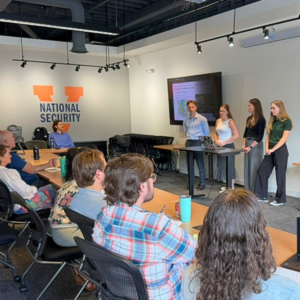 Interns Brooke Livergood, Jane McGuiggin, Maeve Myers, and Peter Sullivan examined a national security question that is subtler than most but carries real weight: what a long record of using natural objects and environmental processes as defense infrastructure can teach today’s policymakers. Their review, Natural Objects and Environmental Processes as Defense Infrastructure, opens with a sobering set of figures. The Department of War manages roughly 5,000 installations worldwide, valued at more than $1 trillion, a third of which sit in coastal areas already facing sea-level rise and extreme weather. Climate-related damage has cost the Department an estimated $15 billion over the past decade alone.
There is a long historical record of societies and armies using natural processes for defensive purposes, and the bulk of students’ research focused on such examples to help inform the predicaments currently facing the DoW. They also examined contemporary approaches, however, recognizing that climate-related damage is not solely a Western problem. China faces a similar predicament, with 44 percent of its population and 61 percent of its GDP concentrated in coastal regions projected to see significant sea-level rise in the coming decades. The interns’ review examines how Chinese policy has responded to that risk, alongside historical and contemporary case studies of how states and non-state actors have used waterways, terrain, forests, and coastlines to advance military and security objectives. The review closes with six takeaways for U.S. policymakers confronting the same environmental pressures on installations at home and abroad. The full literature review, backgrounder memo, and presentation slide deck are available now on the NSPC website’s research page.
Food Security as National Security
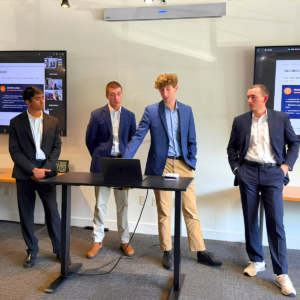
Interns Charles Burns, Rohan Iyer, Phillip Johnson, and Owen Leshner focused on a subject that carries outsized stakes: agroterrorism and the broader landscape of biological threats to the American food supply. Their literature review, Food Security as National Security: A Survey of Natural and Intentional Biological Threats to the U.S. Food Supply, traces how our understanding of agroterrorism has developed since the subject entered mainstream government policy discussions after September 11th.
What the team found is that this understanding hasn’t evolved much since then. Traditional definitions of agroterrorism center on the deliberate introduction of a pathogen into crops or livestock to sow fear and disorder, and while government reporting and academic research on the subject have advanced along a fairly linear path since 2001, they have not kept pace with two fast-moving developments: the infusion of artificial intelligence into synthetic biology, and the spread of AI-generated misinformation about the food system. Their review maps the current methods researchers use to distinguish natural, accidental, and deliberate outbreaks, and identifies where policymakers will need better tools and clearer guidance as these technologies mature. Taken together, the team’s synthesis offers a useful reframing of agroterrorism that could inform future research and carry real-world implications for how the country prepares for both natural and deliberate biological threats to its food supply. The complete literature review, backgrounder memo, and presentation slide deck are also available now on the NSPC website’s research page.
A Field Visit to UVA’s Natural Infrastructure Lab
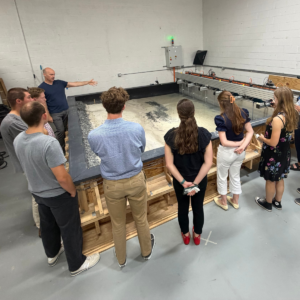 The defense infrastructure team’s research didn’t stay confined to the library. Because the project was written for the Natural Infrastructure Lab (NIL) at UVA’s School of Architecture, the full intern cohort visited the Lab in person to see many of the concepts in their literature review applied in practice.
Co-directed by Brian Davis and Michael Luegering, NIL develops natural infrastructure using plants, sediment, and coastal processes, rather than traditional concrete and steel, to strengthen coastal resilience and flood protection. A recent partner of the NSDPI on new national security initiatives, the Lab gave students a firsthand look at how the natural environment can be designed and managed to protect critical infrastructure.
Looking Ahead
With their team literature reviews complete, this summer’s interns will now turn to individual policy white papers on topics of their own choosing, continuing the two-part internship structure that has come to define the NSPC’s summer program. For national security students weighing a future in the field, and for the government, industry, and academic professionals who rely on this pipeline of talent, these projects reflect the kind of applied research experience necessary to prepare the next generation of analysts and policymakers. We look forward to sharing their individual research later this summer.
Receive NSPC News & Updates
Click below to join our email list so you can receive news, updates, event notices, and more from UVA’s National Security Initiatives.