China’s Maritime Strategy: Next Generation Technologies and the Future of South China Sea Security
Dillon Clark
July 17, 2025
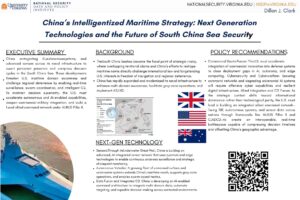 Executive Summary
China is accelerating the integration of artificial intelligence (AI), autonomous systems, and intelligent command networks across its naval and surveillance infrastructure in the South China Sea. Through technologies such as seabed sensors, AI-enabled unmanned vehicles, and real-time data fusion, Beijing is building a maritime system designed to compress decision time, detect stealth platforms, and assert persistent presence in contested waters. Such developments challenge U.S. maritime awareness and undermine the foundations of regional deterrence.
This paper assesses China’s integration of autonomous vehicles (AVs), advanced sensor networks, and AI-enabled command-and-control (C2) systems to enable persistent maritime domain awareness and expand gray-zone operations in the South China Sea. These next-generation capabilities are reshaping the strategic environment by compressing decision cycles and challenging U.S. surveillance dominance. While the United States is advancing in Intelligence, Reconnaissance, and Surveillance (ISR) modernization, unmanned platforms, and multi-domain C2, it is constrained by its geography and its limited regional basing in the SCS.
To maintain maritime advantage, the United States must accelerate development of autonomous platforms, advanced sensing, and AI-enabled C2 by deepening ties with the commercial sector. Yet even the most sophisticated systems are vulnerable to disruption without robust cyber defense and safeguards against adversarial AI. The decisive factor will be informational dominance rather than technological parity. AUKUS Pillar II provides the architecture for a fused multinational surveillance and decision- making network. Integrating allied ISR, command systems, and sensor data streams is essential to offset China’s geographic advantage and preserve decision superiority in the South China Sea.
Download Placemat
Download Full Research
Receive NSPC News & Updates
Click below to join our email list so you can receive news, updates, event notices, and more from UVA’s National Security Initiatives.