Former Office of Foreign Assets Control Chief Counsel Talks with UVA Students
September 25, 2026
Rachel Alpert, a partner at Jenner & Block and former Office of Foreign Assets Control (OFAC) chief counsel, visited UVA on September 24th for a National Security Policy Center Conversations Lunch. Alpert joined students in Garrett Hall to chat about her career progression, working in both the public and private sectors, and the state of economic statecraft today.
Students were thrilled at the opportunity to talk with such an accomplished lawyer in the national security field. After reading about her background, many asked how they could reach the same level of success in their own careers. Alpert provided a helpful analogy, noting that careers are like jungle gyms; they have many different paths.
Alpert’s own jungle gym career has taken her from the Department of State to the Department of the Treasury, and most recently to a private law firm focused on national security crises affecting private companies. Alpert was initially driven to pursue a career in her field because she saw how the law could effect change. Her current role entails utilizing her public experience to contextualize new national security laws for private sector clients, helping them engage with these measures correctly.
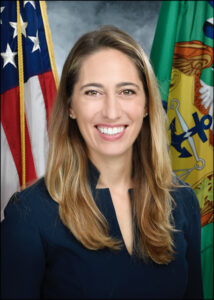 While Alpert’s background was interesting to students, most of the conversation focused on her insight into global affairs and economic statecraft. A common notion about sanctions is that they are ineffective. However, Alpert pushed back on this idea, noting that while sanctions alone will not stop a war, they will certainly make it harder to fight. She pointed out the creative ways that the US and OFAC have used sanctions against Russia to aid Ukraine. The implementation of these sanctions did not end the war but, Alpert highlighted, they have helped Ukraine sustain and defend itself when much of the world assumed Russia would quickly and easily take control of the nation.
However, Alpert noted that just as sanctions alone cannot fix international problems, sanctions have a limited ability to be successful in a vacuum. Specifically, she discussed the need for an increased incorporation of diplomacy and broader policies if the U.S. wants the tool of sanctions to be effective in Iran.
Alpert ended the visit to Charlottesville by providing students in Dr. John Robinson’s Elements of Statecraft course with a comprehensive overview of how sanctions fit into the broader foreign policy tool kit and the intricacies of different types of sanctions. Overall, her engagement was a unique and timely opportunity for students to interact with a practitioner who has played a major role in economic statecraft, especially given the prevalence of sanctions in current U.S. foreign policy.
Receive NSPC News & Updates
Click below to join our email list so you can receive news, updates, event notices, and more from UVA’s National Security Initiatives.