Students and Experts from Across the Nation Join NSPC Military Crisis Simulation
April 24, 2026
Overview
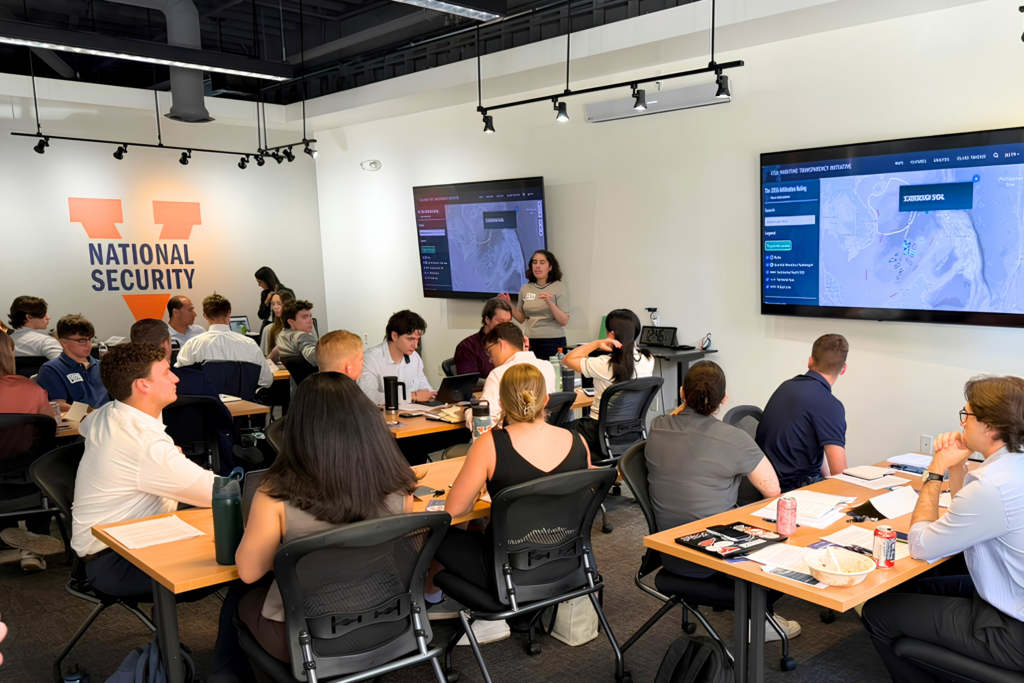
Last week, the University of Virginia’s (UVA) National Security Policy Center (NSPC) welcomed two dozen students from UVA, Texas A&M (TAMU), and Arizona State University (ASU) to a simulation of a gray zone conflict between the United States and China. This exercise mirrored the national security simulation to be featured in The Soldier, The Citizen & The State (LPPP 3559), a Batten course that will be led by Hon. Melissa Dalton, the 28th Under Secretary of the Air Force, during the 2026 fall semester.
Exploring the inevitable tension in the relationship between a democracy and the military that serves it, The Solider, The Citizen & The State will help students build a foundational understanding of the norms and institutions critical to ensuring proper civil-military relations. One of the main objectives of this new course offering is to break down the United States’ siloed approach to developing civilian and military talent through shared, applied coursework and programming. A key element will be a national security simulation in which students will assume roles and responsibilities of civilian and military leaders, hone best practices for healthy civil-military relations, and learn how tactical decisions can have strategic consequences.
Last Friday’s simulation was modeled on this format. Convened in collaboration with ROTC units and the Judge Advocate General School at UVA, the exercise guided students through an exploration of the points at which US military and democratic institutions intersect in the decision-making process. Participants last week broke into groups representing the various military and civilian stakeholders in their simulation’s conflict: the White House (including the President and his National Security Advisor); the Secretary of War; the Chairman of the Joint Chiefs of Staff and the INDOPACOM Commander; the Secretary of State; the Navy ship on the scene; and Congress. The groups were guided by Hon. Dalton and other seasoned national security experts who served as adjudicators.
The Simulation
The incident at the center of this simulation was set at dawn near a disputed area in the South China Sea, the Scarborough Shoal. In the scenario, a US destroyer conducting a Freedom of Navigation Operation (FONOP) in the area receives a distress call from a Filipino supply vessel being surrounded by a swarm of Chinese militia vessels. The US destroyer makes the decision to maneuver between the lead militia vessel and the supply ship to assert navigational rights and create a buffer. It is quickly boxed in, with a heavy trawler approaching on an intercept course. Perceiving an imminent threat, the U.S. destroyer fires warning shots and engages in aggressive electronic warfare jamming. The Chinese vessel swerves violently in response, causing casualties, which triggers a diplomatic breakdown as the crisis becomes public. Beijing portrays the US destroyer as the aggressor, declaring a maritime exclusion zone and putting its anti-ship missile batteries on alert, while Washington scrambles to de-escalate. The speed of Chinese mobilization suggests they intend to use the incident as a pretext to militarize the Shoal completely.
Student Impact
 Confronted with these circumstances, student groups were forced to navigate the conflicting incentives inherent in their roles, making difficult assessments as they received new information about the developing incident. As the situation in the Scarborough Shoal continued to deteriorate, they eventually found themselves forced to choose between risking the Navy vessel on one hand and a wider international conflict on the other.
While the individual problems each student group confronted reflected their institution’s private concerns, they also spoke to larger, open-ended questions about interactions between civilian and military authorities. What are the roles of various civilian and military leaders in shaping the dynamics of an evolving military crisis? How should the United States balance the need for stable relations with China to achieve broader foreign policy and economic objectives in the midst of a military crisis, and at what point does a military crisis supersede other objectives?
 “I was extremely impressed by the students and their level of engagement throughout the process. They were diligent and also thoughtful in addressing multiple courses of action,” said Dr. John Robinson, director of academic programs at the NSPC. “Simulations and other exercises are important to prepare students for future careers in national security. I’m grateful for our partners, who traveled from across the country to make this experience possible.”
Learn More About the New Fall 2026 Course: The Soldier, The Citizen & The State
Receive NSPC News & Updates
Click below to join our email list so you can receive news, updates, event notices, and more from UVA’s National Security Initiatives.